Difficulty Hearing in Background Noise: What a Tone Check Misses
Learn how tone checks differ from speech-in-noise testing, what to note about difficult conversations, and what to ask at a hearing assessment.
An educational guide from Online Hearing Test. Sources linked throughout.
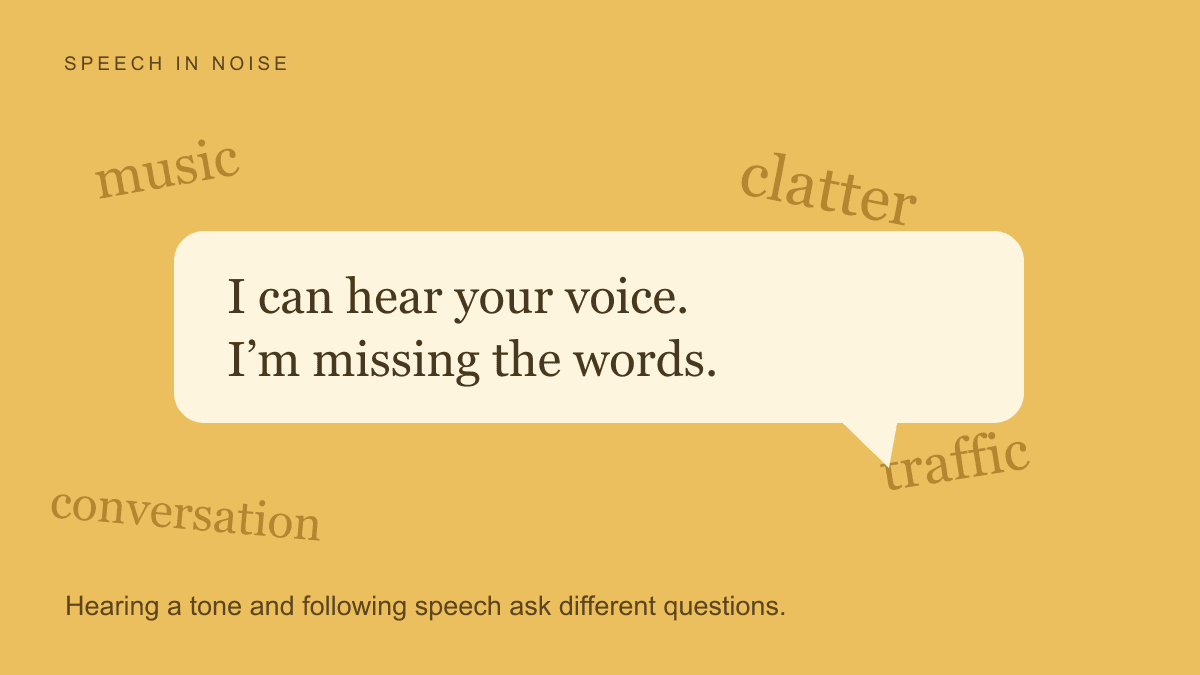
Hearing a sound and following a conversation
You can hear that someone is speaking and still miss the words. A busy café is a familiar example: you follow a friend across the table, then lose the thread when another group starts talking. That experience is worth describing at a hearing appointment, even if you heard every sound in an online check.
Tone testing and speech testing ask different questions. Clinical tone testing measures the quietest tones you can detect at different pitches. Speech testing explores how well you hear and understand spoken material. Audiologists may use both; ASHA’s guide to hearing tests explains why they provide complementary information.
What this online check leaves out
Our free hearing check records responses to tones at six pitches in each ear. It does not play words or sentences against competing voices. There is no speech-in-noise score, and the graph cannot tell you how a restaurant conversation will feel.
The graph also uses uncalibrated relative playback levels. These are not clinical dB HL or measured dB SPL. Your headphones, device settings and room affect what reaches your ears. A low point on this graph does not establish normal hearing, and an uneven pattern cannot identify a cause.
Avoid turning a reassuring-looking graph into a reason to dismiss everyday difficulty. Equally, missing a tone does not explain why you missed a sentence. Keep the two observations separate when you describe them: what happened during the check, and what happens during conversation.
Make your examples specific
Before an appointment, try writing down two or three situations in your own words. You do not need a long diary or a score. Useful prompts include:
- Where were you, and what other sounds were present?
- Was it one speaker, a group, a phone call or a video meeting?
- Did you miss whole sentences or particular words?
- When did you first notice this, and has it changed?
- What would you most like to make easier in daily life?
For example: “I can follow my partner at home, but at our weekly café meeting I keep asking for the last few words.” This gives the appointment a concrete starting point without asking you to diagnose yourself.
Ask about the right assessment
Say explicitly that background noise is your concern. Ask whether speech-in-noise testing would be useful and what the planned tests can answer. ASHA’s clinical assessment guidance includes speech testing in quiet and noise alongside hearing history and other measures. The combination depends on your circumstances.
You can also ask, “If these results do not explain my experience, what is the next step?” That keeps the discussion open. An online label, a single graph or a symptom alone cannot establish a particular hearing disorder.
Use a home result as a conversation starter
If you choose to try the check, the graph and download are available immediately without an account or payment. Bring the report with a note of your headphones and setup, while making clear that it is an uncalibrated home result. Taking it is optional; you can arrange an assessment without one.
If your hearing suddenly drops or worsens over a few days, seek medical attention immediately. Do not wait for an online check or a routine appointment. NIDCD explains why sudden hearing loss is a medical emergency.