How the Ear Works and How Hearing Can Change with Age
Understand the hearing pathway, age-related changes and when to seek help, without treating a home graph as a diagnosis.
An educational guide from Online Hearing Test. Sources linked throughout.
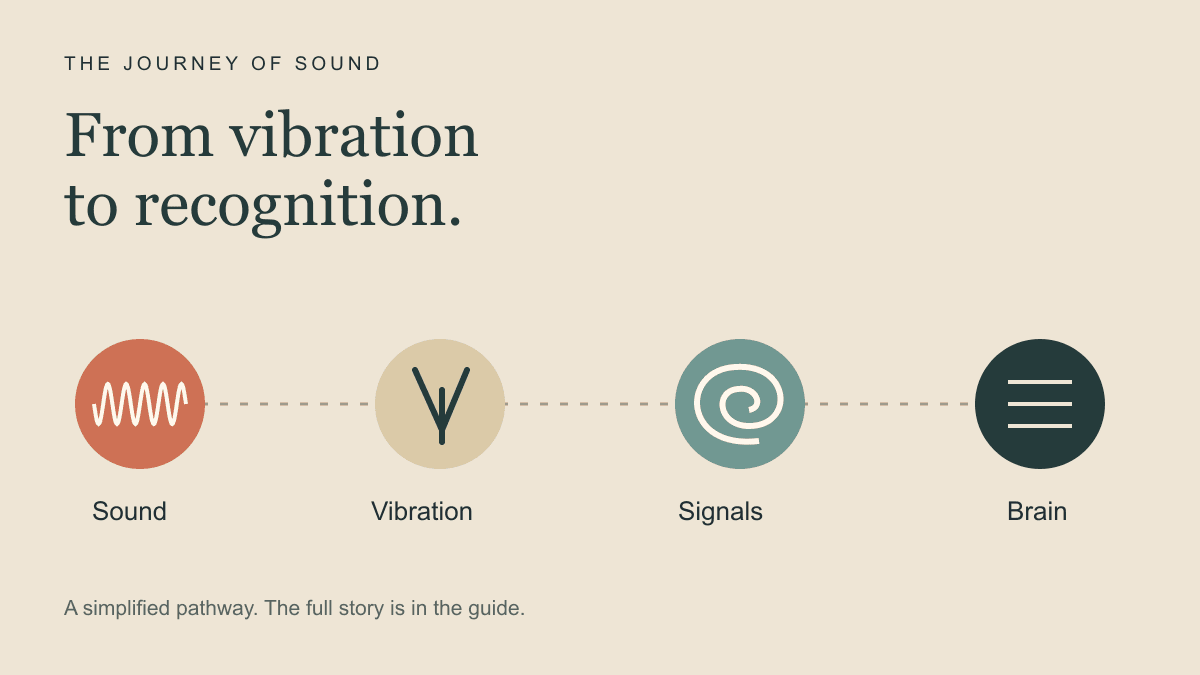
From vibration to a sound you recognise
Sound enters the ear canal and makes the eardrum vibrate. Three small middle-ear bones pass those vibrations to the fluid-filled cochlea in the inner ear. Sensory hair cells help convert the movement into electrical signals, which travel along the auditory nerve to the brain. NIDCD illustrates this journey from sound to perception.
That sequence helps explain why a hearing assessment involves more than asking whether a beep was audible. A response tells us that you noticed a particular presentation. It does not, by itself, locate a problem anywhere along the hearing pathway.
What can change as we get older
Age-related hearing loss usually develops gradually and affects both ears. Changes can involve the inner ear and the pathways that carry sound information. Noise exposure and other health factors may also contribute. NIDCD explains why hearing changes with age.
Age alone cannot explain an individual result. A chart from home headphones cannot distinguish aging from other influences, and comparing its numbers with an age-based average would give them a clinical meaning they do not have.
You may notice difficulty following conversation before you think of yourself as having a hearing problem. NIDCD suggests practical communication changes such as facing the speaker and reducing background noise. Read its advice for conversations with family and friends.
Protect hearing without assuming every change is preventable
Very loud sound can damage hearing. Reducing exposure and using suitable ear protection in loud settings can help prevent noise-related damage. NIDCD explains noise-induced hearing loss and prevention.
For our home check, begin with low device volume and stop if a sound is uncomfortable. Once sound setup is complete, keep the volume fixed. Increasing it to hear every tone changes what the recorded numbers mean; it does not make the check more informative.
When to ask for an assessment
Sudden hearing loss needs immediate medical attention, including when it affects only one ear. Do not attribute a rapid change to aging or wait for a home test. See NIDCD’s sudden-deafness guidance.
For persistent concerns, you can bring examples of difficult listening situations to a hearing professional: group conversations, phone calls or a particular work setting. Describe when the difficulty began and what has changed. You do not need a home graph to justify that conversation.
Where our check fits
The free hearing check is an optional way for adults to record responses at six pitches in each ear. No account or payment is required to view and download the graph. It uses relative playback settings, not calibrated clinical hearing levels, and cannot confirm or rule out hearing loss.
If you request the optional free AI explanation, you consent to sending the recorded responses to Our AI. It does not compare you with age norms, identify a cause or diagnose a condition. Your result remains available without it.